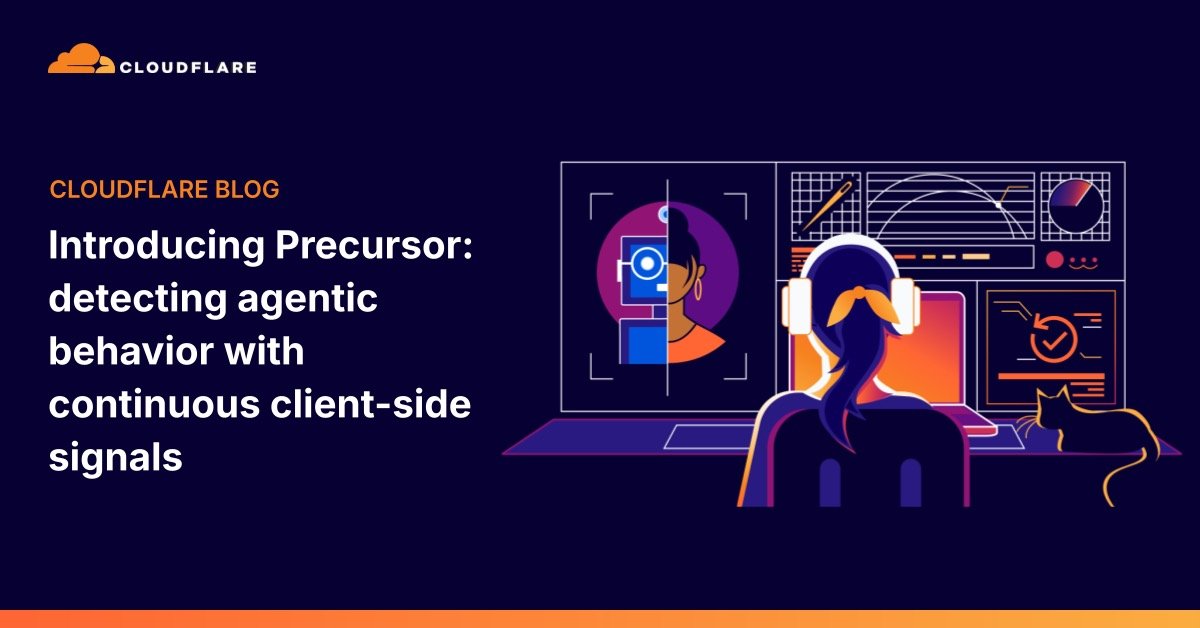
Open your website analytics right now and look at the traffic number. Chances are good that more than half of it isn’t human. On July 13, Cloudflare, the company that sits in front of roughly a fifth of the entire web, put a number on what a lot of marketers and site owners have suspected for a while: automated bot traffic has now overtaken human activity online, with recent industry estimates putting bots at more than 57 percent of all web requests. Cloudflare’s answer is a new tool called Precursor, and it says something important about where the internet is actually headed.
This isn’t a story about spam comments or the old-school “traffic bots” that used to inflate view counts. This is about AI agents, scrapers, and automation tools that now browse the web using real browsers, execute real JavaScript, and pass the CAPTCHAs that used to stop them cold. The old defenses are aging out. That is the real news buried in this launch, and it matters for anyone running a website, an ad campaign, or a content business.
What Cloudflare actually built
Precursor is a continuous behavioral validation engine. Instead of checking whether a visitor is human once, at login or checkout, it watches the entire session. Cloudflare quietly injects a lightweight script into the pages it serves, and that script captures how a visitor moves the mouse, when they type, when they scroll, and when the page actually has their attention.
The system runs in three layers:
- Collection, where the script gathers pointer movement, keyboard rhythm, and visibility signals and quietly sends them back at intervals
- Evaluation, where edge servers cross-reference those signals for consistency, for example confirming that keyboard events only fire when a text field is actually focused
- Session scoring, where the data accumulates across the whole visit so a bot can’t simply refresh the page and reset its behavioral fingerprint
Cloudflare says it deliberately avoided logging anything sensitive. Keystrokes are captured as timing and rhythm, not the actual characters typed, and the scoring happens as an aggregate pattern rather than anything tied to a personal account. It’s rolling out now, free until general availability later this year, and it turns on from the dashboard with no code changes for anyone already using Cloudflare’s Bot Management or Turnstile.
Why this had to happen eventually
For years, the giveaway for a bot was clumsiness. Straight-line mouse movement. Form fields filled in an eyeblink. No scrolling before a click. Basic bot scripts were, frankly, bad actors in the theatrical sense, easy to spot if you knew what to look for.
That stopped being true. Modern automation, much of it now built on the same large language models that power your favorite AI assistant, runs inside real Chromium browsers. It can wait a believable amount of time before clicking. It can even introduce small, randomized mouse jitter to look more human. A one-time CAPTCHA challenge, which is what most of the web still relies on, simply cannot catch behavior this good, because it only checks a single moment instead of a sustained pattern. Cloudflare’s own framing is blunt about this: “what remains difficult to replicate is consistent human behavior over time.” That’s the gap Precursor is built to close, and it’s the same gap most smaller sites and ad platforms haven’t started to address yet.
What this means if you run a business, not a security team
You don’t need to install Precursor yourself to feel the effect of what it’s revealing. A few practical consequences are worth sitting with:
- If a meaningful share of your “visitors” are bots, your bounce rate, session length, and conversion rate are all being quietly distorted, which makes every marketing decision built on those numbers a little bit wrong
- Ad spend is the sharpest edge of this problem. If you run paid traffic to a landing page, a portion of the clicks you’re paying for may never have been a real prospect at all
- Lead forms and “contact us” pages are increasingly targeted by scraping bots harvesting emails and content, not just spam submissions
- AI agents booking things, filling carts, or comparing prices on your behalf, and on your competitors’ behalf, are a fast-growing and mostly invisible category of non-human traffic
None of this means panic. It means treating your traffic dashboard with a healthier amount of skepticism, and asking your hosting provider, ad platform, or agency what they’re actually doing to separate a real prospect from a script.
The tradeoff nobody advertises
Continuous behavioral tracking is, by definition, more surveillance of your visitors than a single CAPTCHA ever was. Cloudflare’s privacy design, aggregating signals instead of storing raw keystrokes, is a reasonable answer to that concern, but it’s still worth naming plainly: the fix for “bots are watching everything” is a system that watches everything a little more carefully than before. That trade will be worth it for most legitimate businesses. It’s still a trade, and it’s one every site owner should understand before flipping it on rather than assuming it’s invisible and free.
What smaller businesses and creators should actually do
Enterprise bot management is not going to be the first move for most small businesses or independent creators, and it doesn’t need to be. What’s worth doing now:
- Look past your top-line traffic number and check your engaged sessions, form completions, and actual replies, not just page views
- If you run paid ads, ask your platform rep directly what invalid traffic filtering they apply, and don’t assume the answer is “all of it”
- If you’re on Cloudflare already, even the free tier, Precursor’s observation mode is worth turning on just to see what your real numbers look like
- Treat a sudden spike in traffic with no matching spike in inquiries or sales as a signal to investigate, not a reason to celebrate
The bigger pattern this points to
Precursor is one company’s product, but it’s a marker of a broader shift. The web spent two decades building defenses against bots that were dumb. It is now racing to build defenses against bots that are, in a meaningful sense, smart, because they’re powered by the same AI models everyone else is using to move faster. That arms race is not going to stay contained to Cloudflare’s customers. Expect every major ad platform, analytics tool, and CMS to be talking about “agentic traffic” within the next year, because the alternative is reporting numbers that quietly stop meaning anything.
The takeaways
- Cloudflare’s new Precursor tool signals that AI bot traffic has become common enough that one-time checks like CAPTCHAs are no longer enough on their own
- Recent estimates put automated traffic above half of all web requests, which means your own analytics are likely more inflated than you think
- The practical risk for most businesses isn’t hackers, it’s distorted marketing data and wasted ad spend from traffic that was never a real prospect
- Behavioral tracking is a real privacy tradeoff, even when it’s built thoughtfully, and it’s worth understanding rather than ignoring
- You don’t need enterprise tools to respond, just a habit of checking engagement quality, not just traffic volume
Frequently asked questions
What is Cloudflare Precursor?
Precursor is a bot detection tool Cloudflare launched in July 2026 that continuously analyzes visitor behavior, like mouse movement and typing rhythm, throughout an entire website session instead of checking only once at a single checkpoint like a CAPTCHA.
How much of website traffic is actually bots?
Recent industry estimates cited around Precursor’s launch put automated bot traffic above 57 percent of all web requests, meaning more than half of the activity hitting many websites today may not come from real human visitors.
Do I need a tool like Precursor for my small business website?
Most small businesses don’t need enterprise-grade behavioral bot detection immediately, but it’s worth checking whether your existing host, ad platform, or analytics provider filters invalid traffic, and treating a spike in visits with no matching spike in real inquiries as a warning sign.
Related reading
- The Honest Guide to AI for Small Business Owners
- 5 AI Tools That Save B2B Marketers 10 Hours a Week
- What Nobody Tells You About Running Paid Ads for Events
Image: Cloudflare
Follow Osato Tech and AI for straight takes on what’s actually changing in tech, not just the hype.