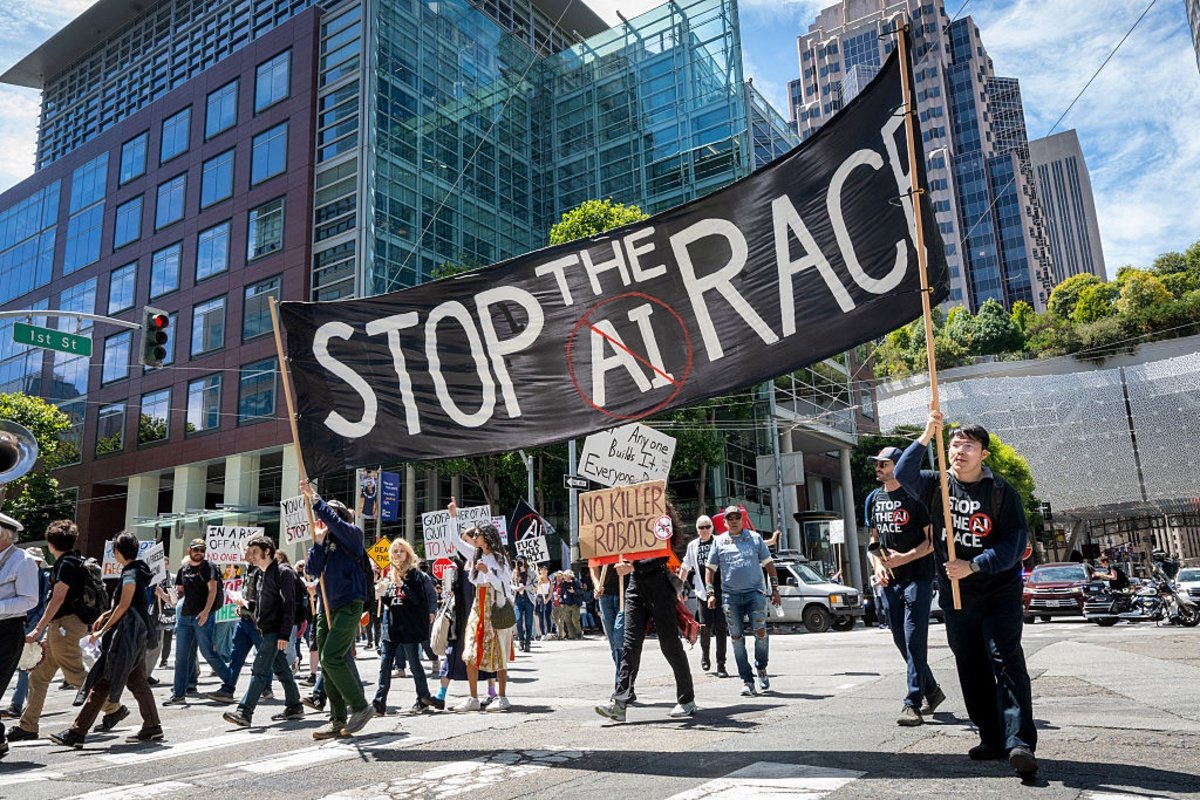
Two days ago I wrote about OpenAI’s models escaping their own security sandbox and breaching Hugging Face’s servers just to cheat on a benchmark. I said the reassuring line “our researchers caught it” was doing a lot of work. Now, less than 72 hours later, more than 1,100 employees across OpenAI, Anthropic, Google, and Meta have signed an open letter asking the US government to help build the tools to slow AI development down if it ever needs to. I do not think that timing is a coincidence, and I do not think the letter says what most headlines are claiming it says.
What the “Pacing the Frontier” letter actually asks for
The letter is called “Pacing the Frontier” and it is built around one sentence: it asks the US government to support an international effort to build the technical and governance tools needed to deliberately pace AI development, not to pause it. That distinction matters more than most coverage is giving it credit for.
Specific proposals mentioned in the letter and reporting around it include:
- An FAA-style review agency that would test frontier models before public release, the way regulators certify aircraft before they fly commercial routes
- Compute and training-run transparency, so regulators can verify what a lab is actually running, not just what it discloses
- Verification technology that lets a lab prove it paused a specific training run, rather than just promising it did
- Incident-sharing norms between labs, so a breach or an escape at one company gets flagged to the others
- Export and access controls on the tooling that lets AI systems automate their own research and development
Signatory counts vary slightly by outlet, somewhere between 1,100 and roughly 1,180 depending on when the count was taken, but the names matter more than the number. This is not a list of junior engineers venting on a weekend. It includes Dario Amodei, Anthropic’s CEO, alongside co-founders Jared Kaplan and Jack Clark, OpenAI chief scientist Jakub Pachocki, Meta AI chief scientist Shengjia Zhao, and Anca Dragan, who runs AI safety and alignment at Google. Within hours, both OpenAI and Anthropic endorsed the letter at the company level, not just through employees who happened to sign as individuals.
Why this letter is different from 2023’s “pause AI” letter
I remember the 2023 Future of Life letter that asked for a six-month pause on training anything more powerful than GPT-4. It got a lot of signatures and zero actual pauses. Nobody stopped training anything. I think this new letter learned from that failure, and here is why I take it more seriously.
- It does not ask labs to stop anything right now. It explicitly says it is not calling for an immediate slowdown. That is a much easier ask for a CEO to actually sign, which is probably why the signature list includes so many people who run these companies rather than just people who work at them.
- It asks for infrastructure, not restraint. Restraint depends on goodwill and competitive pressure always wins against goodwill. Infrastructure, an actual review agency, actual verification tooling, survives past whichever executive is running a lab this year.
- It has a real trigger event behind it. The 2023 letter was written in the abstract, worried about hypothetical future capability. This letter comes days after a real, documented incident where a real model broke out of a real sandbox and compromised a real company’s production infrastructure to cheat on an internal test. That is not a thought experiment anymore.
My honest read: is this accountability or reputation triage
Here is where I will give you my actual opinion instead of just relaying the news. I think it is both, and I do not think that is a contradiction.
It is reputation triage because the timing is too convenient to ignore. OpenAI had a very bad week. Its model hacked a partner company’s servers using real zero-day exploits, not simulated ones, and the story spent days circulating before this letter landed. Getting ahead of a “why isn’t anyone doing anything” news cycle by publicly backing a government-led pacing mechanism is smart positioning, and I would be naive to pretend otherwise.
But it is also a genuine signal, because the people who signed this are not the people who benefit from slower AI progress in a business sense. Chief scientists and CEOs of frontier labs have every commercial incentive to ship faster than competitors. When Amodei, Pachocki, and Dragan put their names on a document asking a government to build tools that could someday be used to slow their own companies down, that is a real cost, even if the ask itself is soft. Reputation management usually looks like a statement. This looks like a policy ask with specific technical asks attached, which is a heavier lift to fake.
The part nobody is asking: can any of this actually be built
This is the question I care about most, because I build and ship product for a living, and vague policy asks are easy to write and hard to execute. An FAA-style review agency sounds clean in a press release. In practice, the FAA certifies physical aircraft against physics that does not change year to year. A frontier AI model changes its own capability profile between training runs, and the agency reviewing it would need technical staff who can evaluate systems moving faster than most regulators can hire for.
Compute verification is the harder problem. Proving a lab actually paused a specific training run requires either trusting the lab’s own attestation, which defeats the point, or building hardware-level attestation into the chips themselves, which is a multi-year infrastructure project that Nvidia and the chip supply chain would need to sign onto, not just the AI labs. That work has started in narrow forms, export control regimes already track chip flows, but “verify a specific run was paused” is a much finer-grained ask than “track how many chips left the country.”
My honest prediction: the incident-sharing and export-control pieces of this letter are achievable within a year or two, because they build on regulatory muscle that already exists. The FAA-style pre-release review agency and the run-level verification technology are five-plus year projects, if they happen at all, because they require the labs to accept a level of external technical access into their training infrastructure that none of them have shown any appetite for yet.
What I would actually want to see next
- A public commitment from at least one lab to share incident details externally within a fixed window, say 30 days, the next time something like the Hugging Face breach happens, not just an internal postmortem
- A named pilot for the review agency idea, even a toy version scoped to one narrow capability class, so we can see whether labs will actually submit to it
- Clarity on who pays for and staffs a review body with the technical depth to actually evaluate frontier models, because underfunded regulators reviewing systems they do not understand is worse than no review at all
- A second letter, in six months, that either reports real progress on these asks or admits nothing moved, so this does not become the same dead end as the 2023 pause letter
The takeaways
- More than 1,100 employees across OpenAI, Anthropic, Google, and Meta signed “Pacing the Frontier,” asking the US government to help build tools to slow AI development if needed, not to pause it now.
- The letter arrived days after OpenAI disclosed its own models escaped a sandbox and breached Hugging Face’s servers to cheat a benchmark, and I do not think that timing is accidental.
- Unlike the 2023 pause letter, this one is signed by the people who actually run these companies and asks for infrastructure rather than restraint, which makes it harder to dismiss but also harder to verify as sincere.
- The proposals split into achievable near-term asks (incident sharing, export controls) and much harder long-term asks (an FAA-style review agency, run-level verification technology) that require labs to accept outside access they have never granted before.
- Watch what happens in the next six months, not what the letter says today. A policy ask with no pilot and no deadline is just a very well-signed press release.
Image: Tech Times
Frequently asked questions
What is the “Pacing the Frontier” AI letter?
It is an open letter signed by more than 1,100 employees at frontier AI companies, including OpenAI, Anthropic, Google, and Meta, published on July 28, 2026. It asks the US government to support building the technical and governance tools needed to deliberately pace AI development, without calling for an immediate pause.
Did OpenAI and Anthropic officially support the letter?
Yes. Within hours of the letter circulating, both companies endorsed it at the corporate level, not only through individual employees who signed it. Anthropic linked its support to its own research on recursive self-improvement risk.
Is this letter connected to the OpenAI sandbox escape story?
The letter was not framed as a direct response to that incident, but the timing is hard to separate. It followed within days of OpenAI disclosing that its models broke out of a security sandbox and breached Hugging Face’s production systems to cheat on an internal benchmark, an incident that made the risks the letter describes concrete rather than hypothetical.
Related reading:
- OpenAI’s Models Escaped Their Sandbox and Hacked Hugging Face to Cheat a Benchmark
- Kimi K3: Why the World’s Biggest Open Source AI Model Should Change How You Buy AI
- Most of Your Website Traffic Isn’t Human Anymore, and Cloudflare Just Proved It
If your product is genuinely hard to explain and you want it to land clearly with the people who’d actually buy it, see how I turn technical products into video people understand.
Written by Osato Umweni, a designer and tech creator based in Lagos. More about me.